Reasoning Models Are Rewriting How Developers Use AI — What Changed With o3, Fable 5, and Gemini 3.5
When OpenAI shipped o1 in late 2024, the model did something that felt qualitatively different from its predecessors. It paused before answering hard questions — sometimes for several seconds — and when it responded, it showed its work. Not just the answer, but the chain of intermediate steps that led there. Benchmark scores jumped. Code quality improved on complex problems. The math was suddenly better, not by a little but by a lot.
That shift — from language models that pattern-match to language models that reason — is now mainstream. o3 and o3-mini are OpenAI's current production reasoning models. Anthropic's Fable 5 (launched June 2026) integrates extended reasoning as a first-class capability within its flagship tier. Google's Gemini 3.5 Flash is positioned as the efficient reasoning option, trading some quality for speed. The era of reasoning-first AI is no longer a preview — it is the default for serious tasks. But what that actually means for how developers build and deploy AI is less understood than the benchmark headlines suggest.
What reasoning models actually do differently
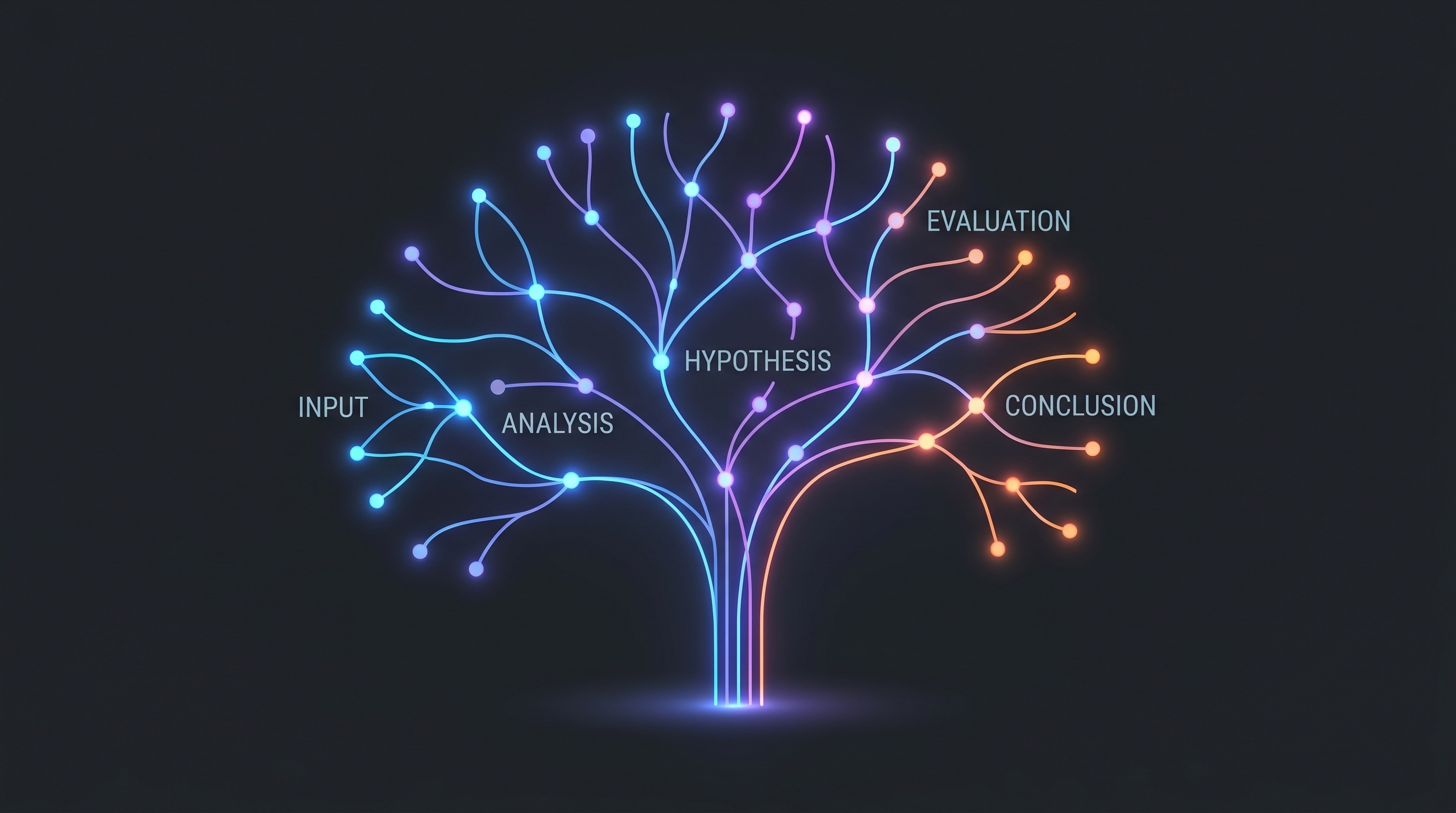
The core mechanism is test-time compute scaling — letting the model spend more computation at inference time rather than only at training time. A traditional language model produces one forward pass per token. A reasoning model generates a scratchpad of intermediate tokens (the "thinking" that is sometimes visible, sometimes hidden), then synthesizes a final answer from that process. The model is essentially running multiple drafts internally before committing to an output.
This matters for a specific class of problems: those where the right answer depends on correctly executing a sequence of steps where early errors compound into late failures. Mathematics, symbolic logic, multi-step code generation, planning under constraints, and certain types of analysis all fit this profile. The model does not just answer faster or with more confident language — it actually makes fewer errors on problems that require getting intermediate steps right.
Crucially, this does not improve all tasks equally. For factual retrieval, creative writing, summarization, classification, and simple generation, reasoning models offer little improvement over their base counterparts while costing significantly more. A question like "what is the capital of France?" does not benefit from extended thinking.
How the major models differ
OpenAI o3 is currently the highest-performing reasoning model on benchmarks like ARC-AGI (which tests novel reasoning rather than pattern recall), SWE-bench (software engineering from real GitHub issues), and competition math. o3 scored 88% on ARC-AGI, a test that earlier frontier models routinely failed at 30-40%. It scored 71.7% on SWE-bench Verified, resolving most software engineering tasks that would require a junior developer hours to tackle. The cost is commensurate: o3 is priced at $10 per million input tokens, $40 per million output tokens — roughly 10x the price of GPT-4o for most use cases.
Claude Fable 5 (Anthropic's June 2026 flagship) integrates reasoning more deeply than the o-series architecture. Rather than a separate model tier, Fable 5 applies extended reasoning to complex queries while falling back to standard generation for simpler ones — making it more automatic and less dependent on developers explicitly selecting a "reasoning mode." Anthropic's positioning emphasizes that Fable 5 matches or exceeds o3 on coding tasks while being meaningfully better on nuanced instruction following and long-form analysis, though the two models trade positions depending on the benchmark and evaluator methodology.
Gemini 3.5 Flash represents Google's bet on efficiency: a reasoning model fast enough and cheap enough to use in latency-sensitive production paths. It is not the highest performer on pure reasoning benchmarks but is competitive on the practical tasks most applications actually need — code review, document analysis, structured data extraction from complex inputs. Google has positioned it as the default choice for production pipelines where cost and latency matter and absolute ceiling quality does not.
What changes for developers
The prompt engineering playbook that most developers built in 2023-2024 needs to be updated. Several techniques that were critical for base models matter less for reasoning models, and new practices have emerged.
Few-shot examples become less necessary. Chain-of-thought prompting — where you provide a few worked examples to show the model how to reason step-by-step — was one of the most reliable techniques for improving base model accuracy on structured tasks. Reasoning models have largely internalized this capability. You still benefit from clear task specification and examples of the desired output format, but you no longer need to walk the model through the reasoning process explicitly.
Problem framing matters more, not less. Reasoning models do not fix underspecified problems — they reason longer about them and produce more confident wrong answers. The single highest-value prompt engineering practice for reasoning models is specifying what "correct" looks like precisely: what constraints must hold, what the output format must be, what assumptions to make when information is missing. Vague prompts produce expensive hallucinations.
Latency is a real constraint. Extended thinking takes time. o3 can take 10 to 30 seconds to respond to complex queries, sometimes longer. This is fine for batch jobs, asynchronous processing, or human-in-the-loop workflows. It is a showstopper for anything with a real-time user-facing component. The architectural implication: reasoning models belong in the planning layer of an agentic system, not in the generation layer that produces token-by-token streaming responses to users.
The cost-quality tradeoff and when to use reasoning models
Reasoning models cost 5x to 15x what a base frontier model costs for equivalent token counts, and they use more tokens (the scratchpad adds to the output). The economics only work if the quality improvement changes outcomes meaningfully for the use case. A rough decision framework:
Use a reasoning model when: the task involves multi-step logic that fails often with base models; errors are costly (code that ships to production, analysis that drives decisions); you can absorb latency of 5-30 seconds; you are solving a small number of hard problems per unit time rather than many easy ones.
Stick with a base model when: the task is primarily about fluent generation, creative output, retrieval, summarization, or classification; latency is measured in seconds rather than tens of seconds; you are processing high volumes; errors are recoverable with human review.
The most effective production pattern in 2026 is a hybrid: a reasoning model handles planning, task decomposition, and quality checks; a faster, cheaper base model handles execution, generation, and high-volume operations. This mirrors how skilled teams work — senior judgment applied at decision points, rapid execution on well-defined tasks.
What to watch next
The reasoning model wave is not done. Test-time compute scaling (more thinking time → better answers) appears to show returns that do not plateau as quickly as training-time scaling did. The implication is that the gap between reasoning and non-reasoning models will likely widen before it narrows, particularly on problems that require sustained, correct multi-step logic.
For developers building AI applications today, the actionable insight is to audit your production pipelines for the tasks where you see the most failure. If those failures involve multi-step reasoning — not hallucination of facts, but errors in logic or task execution — a reasoning model almost certainly produces better results. The cost is real, but so is the quality delta. Building on base models for everything in 2026 is like writing single-threaded code when multicore processors exist: technically fine, practically limiting.