Reusable boosters solved the easy half of rocket reuse. The upper stage is the hard half.
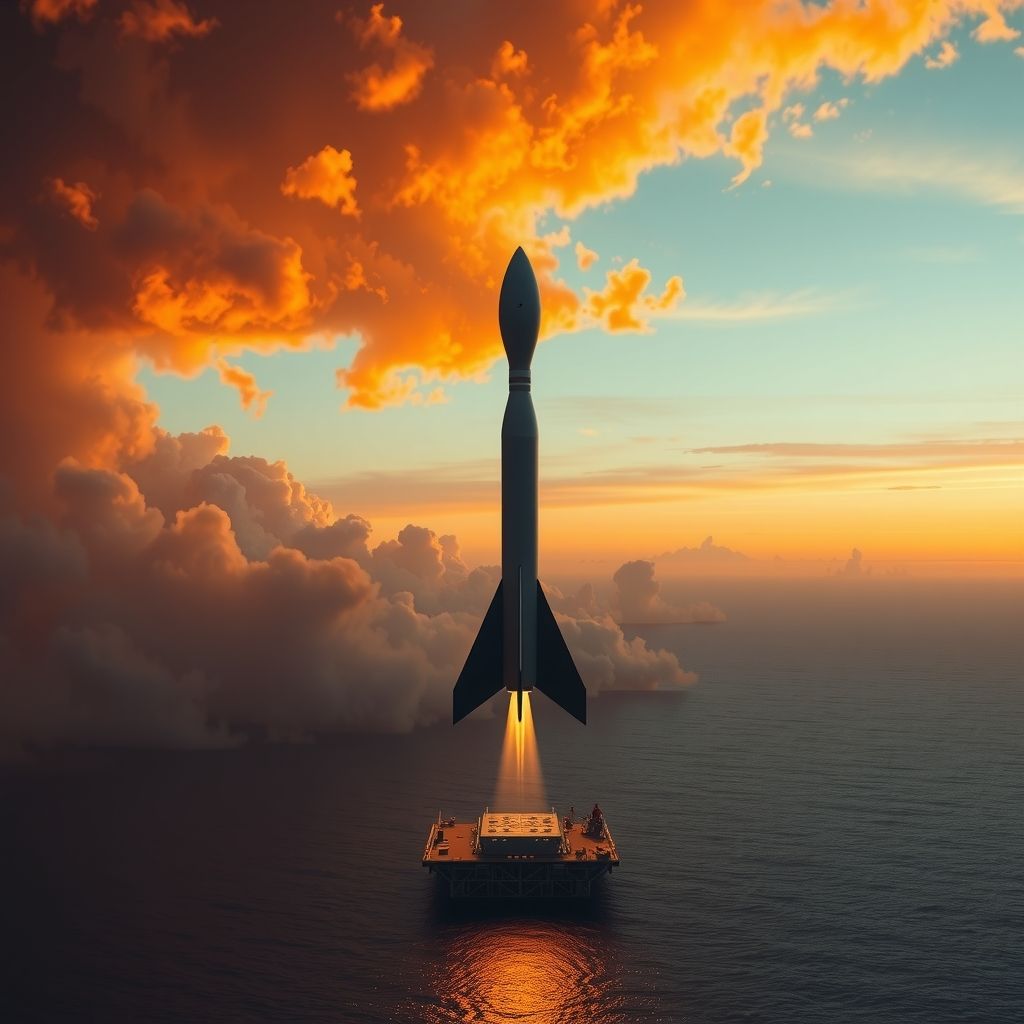
Every major new rocket announced in the last five years reuses its first stage. None of them, except SpaceX's Starship and the much smaller Stoke Space Nova, attempts to reuse the second. That asymmetry is not an oversight — it is because the upper stage is a fundamentally harder engineering problem, and it is quietly becoming the real ceiling on how cheap orbital launch can get.
The booster was always the easier target
A first-stage booster on a vehicle like Falcon 9 burns for about two and a half minutes, reaches roughly 2,000–2,500 meters per second, and separates at an altitude where atmospheric heating during descent is manageable with a simple ablative or no heat shield at all. It flies a ballistic arc back down, relights its engines for an entry burn and a landing burn, and touches down on a drone ship or landing pad. SpaceX has done this well over 400 times. Rocket Lab's Neutron and Blue Origin's New Glenn copy the same architecture: a reusable first stage, built to survive repeated low-velocity, low-heat re-entries.
The second stage faces a completely different physics problem. Its job is to finish the push to orbital velocity — around 7.8 kilometers per second for low Earth orbit, more than three times faster than the booster ever goes. Bringing something back from orbital velocity means dissipating an order of magnitude more kinetic energy, through a thermal environment closer to a crewed capsule's re-entry than a booster's hop. That is why every operational orbital rocket today, Falcon 9 included, still expends its second stage on every single flight.
Why this is the actual cost floor
Once a booster is reusable and refurbishment costs drop into the low millions per flight, the expendable upper stage stops being a rounding error and becomes the dominant line item. Industry cost estimates for a Falcon 9-class upper stage — engine, tankage, avionics, built once and flown once — run somewhere in the $5–12 million range, even as SpaceX has pushed reused-booster refurbishment down toward $1–2 million per flight. On a reused Falcon 9 with a marginal launch cost widely estimated near $15–20 million, the upper stage can account for well over half of what's left.
New Glenn and Neutron inherit the same math. Both are designed around a reusable booster and an expendable upper stage, which means both have a hard floor on marginal cost that no amount of booster reuse can push below the price of building a new second stage for every flight. Booster reuse was the right first problem to solve — it required less exotic thermal protection and had the biggest early payoff — but it was never going to be the whole answer to cheap access to orbit.
Who is actually trying to solve the hard half
Starship is the only vehicle in active flight testing attempting full-stack reuse, including an orbital-velocity upper stage that re-enters belly-first using ceramic tiles for thermal protection, then performs a flip-and-catch maneuver. The difficulty shows in the flight record: tile loss, burn-through risk, and reliability across repeated flights have been the persistent technical thread through Starship's test campaign, precisely because this is the harder half of the reuse problem that no one else has attempted at this scale.
The more interesting long-term signal might be Stoke Space, a smaller Washington-state startup building its Nova rocket around a fully reusable upper stage from day one, using an actively cooled metallic heat shield instead of ablative tiles or Starship-style ceramics. Stoke's bet is that an actively cooled structure can survive dozens of orbital-velocity re-entries with minimal refurbishment, the same logic that let jet engines move from disposable to overhaul-and-reuse decades ago. It is a small company with an unflown orbital vehicle, but it is the only one explicitly designing for upper-stage reuse rather than treating it as a stretch goal bolted onto an already-flying booster.
What to watch instead of booster headlines
Booster landings are the photogenic part of reusability and they make for good footage, but they stopped being the interesting cost question around the time Falcon 9 booster reuse became routine. The number that actually predicts how cheap launch gets from here is the upper-stage reuse rate and refurbishment cost — how many flights a given upper stage survives before it needs to be scrapped, and how much work goes into turning it around between flights. For Starship, that means watching tile retention and turnaround time across consecutive flights, not just whether the booster catches cleanly. For the rest of the industry, it means watching whether anyone besides Stoke Space commits upper-stage reuse to their roadmap instead of accepting an expendable second stage as the cost of doing business.
If you're modeling launch costs for a payload, satellite constellation, or any plan that depends on where launch prices go over the next five years, build your estimate around upper-stage economics, not booster cadence. Booster reuse is a solved problem generating diminishing returns. Upper-stage reuse is the unsolved problem that will actually move the price per kilogram to orbit.