Nuclear Fusion Crossed the Break-Even Threshold. Here Is What Q>1 Actually Means and When a Power Plant Arrives.
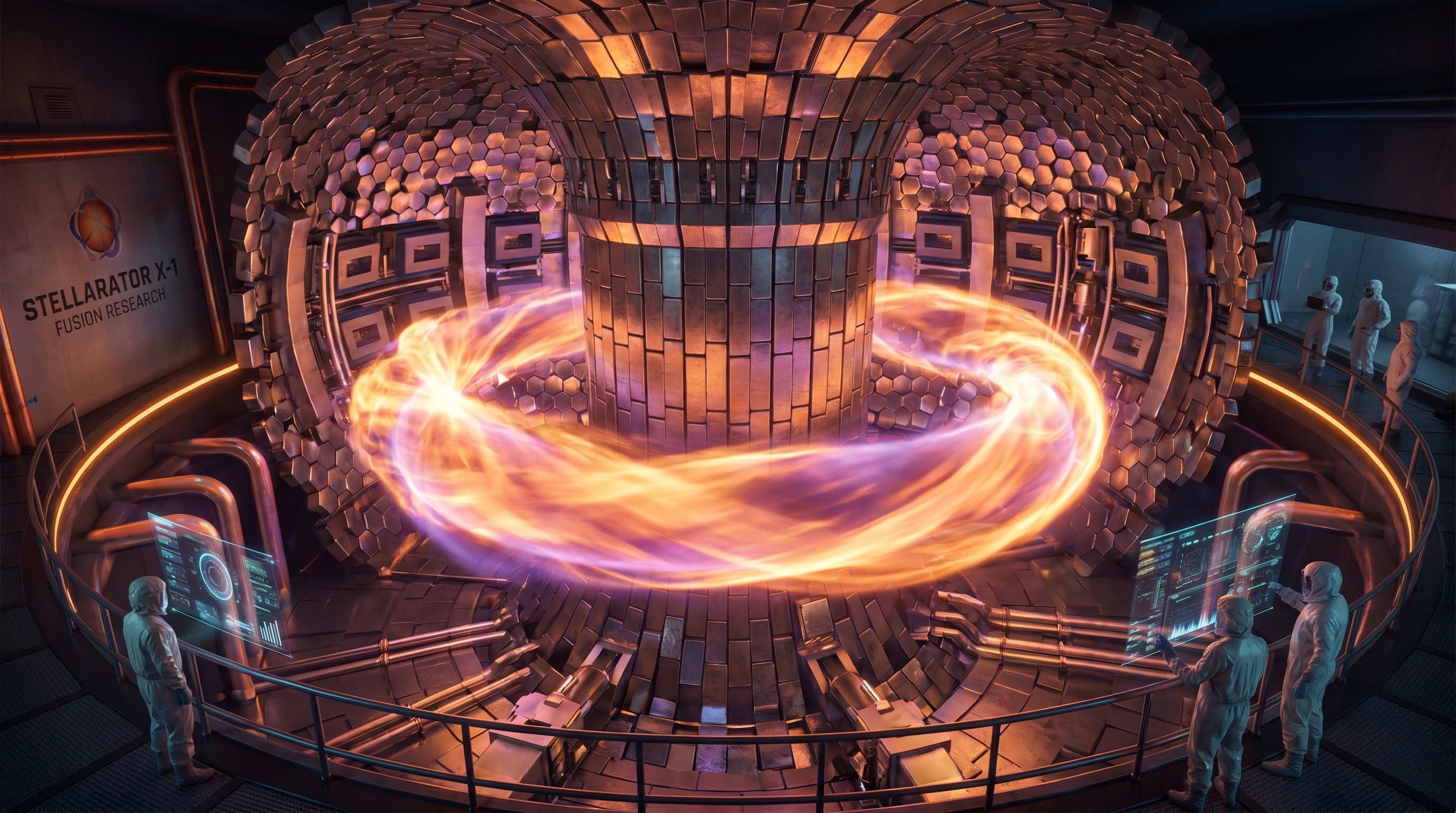
In December 2022, a team at the National Ignition Facility (NIF) at Lawrence Livermore National Laboratory achieved something that physicists had been chasing for 70 years: a nuclear fusion reaction that produced more energy than the laser energy delivered to the fuel target. The shot produced 3.15 megajoules of fusion energy while consuming 2.05 megajoules of laser energy. Q = 1.54. Scientific ignition, confirmed.
The headlines were justified. This was a real milestone, achieved by a real experiment with real diagnostic measurements. But "scientific break-even" is one of several very different definitions of Q>1, and the gap between the one NIF achieved and the one needed for a commercially viable power plant is significant enough to require a clear-eyed explanation. What happened at NIF matters enormously; it just does not mean fusion power is around the corner.
What Q actually means — and why there are three different definitions
Q is the ratio of fusion energy output to energy input. The problem is that "energy input" can be defined in at least three ways, producing Q values that differ by orders of magnitude for the same experiment.
Q_target (scientific Q): The ratio of fusion energy produced to the energy delivered to the fuel target by the laser. This is what NIF achieved at Q > 1 in 2022. The laser itself consumed about 300 megajoules of electricity to deliver 2 megajoules to the target — meaning the actual energy balance for the facility was Q_wall ≈ 0.01.
Q_laser (driver efficiency): The ratio of fusion energy to all the electrical energy consumed by the laser system. NIF's lasers are roughly 1% efficient. Getting Q_laser > 1 would require 100x improvement in either laser efficiency, fusion yield, or both — a fundamental engineering challenge, not just optimization.
Q_wall (commercial Q): The ratio of electricity delivered to the grid to all electricity consumed by the facility, including plasma heating, cooling, control systems, and facility overhead. For a commercial fusion plant to make economic sense, Q_wall must typically exceed 5 to 10, accounting for the thermal-to-electric conversion efficiency of roughly 30-40%.
NIF's achievement is a genuine scientific milestone because it proves the physics works at the target level. But the path from Q_target > 1 to Q_wall > 1 in a commercially viable plant involves engineering challenges that are almost as hard as the physics itself.
The tokamak approach: ITER and Commonwealth Fusion Systems
Most of the serious private and public fusion investment is not following the laser path NIF uses (inertial confinement fusion). It is following the tokamak approach — using powerful magnetic fields to confine a plasma of deuterium and tritium heated to 100 million degrees Celsius until fusion occurs.
ITER, the international megaproject under construction in Cadarache, France, represents the institutional bet on tokamak physics. The project involves 35 nations and has consumed roughly €20 billion in investment to date. ITER's goal is to achieve Q_plasma = 10 (10x more fusion power out than plasma heating power in), demonstrating that the physics of net energy gain is achievable at scale. It is not designed to produce electricity — it is a proof of concept. First plasma is expected in 2025, with full deuterium-tritium experiments not planned until the early 2030s at the earliest. ITER has experienced repeated delays and cost overruns. Its timeline is not inspiring confidence among private investors.
Commonwealth Fusion Systems (CFS) is doing something more interesting. Spun out of MIT's Plasma Science and Fusion Center in 2018, CFS built the world's strongest superconducting magnet (20 tesla) in 2021 using high-temperature superconductor (HTS) tape that was not commercially available when ITER was designed. Stronger magnets let you build smaller tokamaks that achieve the same confinement — the physics scales favorably. CFS's demonstration device, SPARC, is targeting Q_plasma > 2 in a machine that fits in a large room rather than a sports stadium. As of 2025, SPARC was under construction in Devens, Massachusetts. If it works, the commercial plant (ARC) would follow — targeting first electricity in the early 2030s.
Private fusion funding and the startup landscape
Over $7 billion in private capital has flowed into fusion startups through 2025, according to the Fusion Industry Association's annual census. The funding has accelerated the field in ways that government programs could not.
Helion Energy has raised more private fusion capital than any other company — over $2.2 billion, including a round led by Sam Altman. What makes Helion unusual is that it has a signed power purchase agreement with Microsoft for 50 megawatts of fusion electricity by 2028. This is either the most audacious customer contract in the history of energy or a milestone that will slip. Helion's approach (field-reversed configuration, or FRC) differs from both laser fusion and the conventional tokamak. The company claims it can extract electricity directly from the fusion plasma via induction, bypassing the thermal conversion step that limits conventional generator efficiency.
TAE Technologies, formerly Tri Alpha Energy, has raised over $1.2 billion and is backed by Goldman Sachs, Chevron, and Google. It uses a different plasma confinement approach and has been in development since 1998. TAE's timeline for commercial viability has shifted multiple times.
General Fusion (backed by Jeff Bezos, Chevron, and the Canadian government) uses magnetized target fusion — compressing a plasma contained in liquid lithium using mechanical pistons. It has completed a technology demonstration center in the UK and is working toward a pilot plant.
What "commercial fusion" actually requires
The engineering problems between "plasma achieves net energy gain" and "electricity delivered to the grid at competitive cost" are considerable. Tritium breeding is a good example: deuterium-tritium fusion produces helium and a high-energy neutron. That neutron needs to be captured in a lithium blanket to breed new tritium (the rare fuel), while simultaneously generating heat to drive a turbine. Building a lithium blanket that can survive neutron bombardment for years, breed enough tritium to be self-sustaining, and transfer heat efficiently is an engineering challenge comparable in difficulty to the plasma physics itself.
Material science is a related problem. The first wall of a fusion reactor faces conditions comparable to having a nuclear weapon detonating nearby every second, sustained for years. No material with the required properties has been tested at the required scale for the required duration.
None of this means commercial fusion is impossible or even unlikely on a multi-decade horizon. It means that the jump from "lab ignition" to "operating power plant" involves multiple unsolved engineering problems rather than a single physics breakthrough.
The realistic timeline
The most credible near-term milestones in roughly chronological order: SPARC (CFS) demonstrates Q_plasma > 1 in the mid-2020s if construction stays on schedule; ITER achieves first plasma and runs DT experiments through the 2030s; the first demonstration fusion plant connected to the grid — from CFS, Helion, or another startup — arrives in the early to mid-2030s if development continues without major setbacks; commercial deployment at meaningful scale (enough plants to affect global electricity supply) is plausibly 2040s, though scenarios exist that are faster or slower.
The honest answer to "when does fusion power the grid?" is: probably in your lifetime if you are under 50, but not in time to be the primary solution to the 2030s climate commitments that most countries have made. Fusion power matters enormously for the second half of this century. It is not a meaningful contributor to the decarbonization challenge we face in the next decade.
What NIF proved, and what CFS and Helion are now betting on, is that the physics is not the barrier. That is genuinely significant. The barriers ahead are engineering, materials, economics, and time. That is a much better set of problems to have than unsolved physics — but it is not the same as having solved the problem.